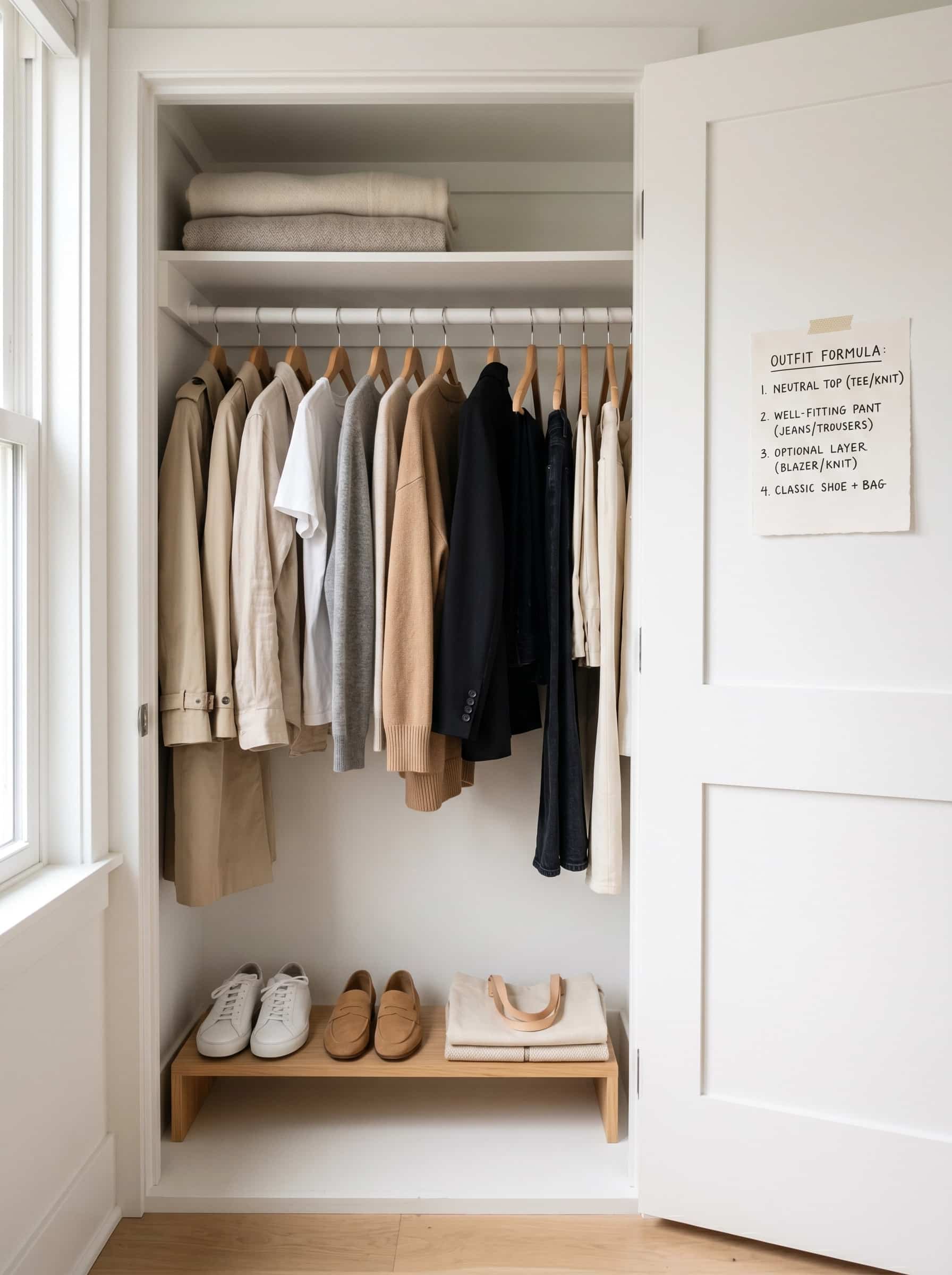
I have stood in front of a full closet at 7:15 a.m. with wet hair, a cup of coffee going cold, and the absolute conviction that I had nothing to wear. This happened not because my closet was empty, but because it was loud. Too many choices. Too many pieces that did not connect. Too many decisions waiting to be made at the worst possible time of day.
After years of styling clients and organizing wardrobes, I learned something that changed my mornings completely: a closet that works is not one with more clothes. It is one with better systems. When your wardrobe is set up to serve you, getting dressed takes two minutes and costs zero stress. Here is exactly how to build that closet, step by step.

The Real Problem Is Not Your Clothes. It Is Your Closet Setup.
Most women I worked with as a stylist believed they needed more pieces to solve their morning problem. What they actually needed was to see what they already owned and to have those pieces arranged in a way that made outfits visible, not buried. The table below outlines the most common closet problems I encountered and the simple fixes that solved them immediately.
Common Morning Problem | Why It Happens | The Fast Fix |
|---|---|---|
You stare at a full closet and feel like you have nothing | Too many orphan pieces and no visible outfit combinations | Group clothes by outfit formula, not by category. Hang a complete outfit together on one hanger. |
You try on three things and leave them in a heap on the bed | The pieces you reach for do not work together, so you keep discarding | Edit out anything that does not pair with at least three other items in your closet. |
You default to the same tired outfit every day | Decision fatigue sets in and you grab what is easy, even if it makes you feel flat | Pre-plan three outfit formulas every Sunday and hang them at the front of the closet. |
You run late because you cannot find a specific piece | Closet is overcrowded and items are hidden behind each other | Remove out-of-season clothes to a separate storage space. Keep only current pieces visible. |
You feel uninspired even though you own plenty | Everything looks the same or nothing looks intentional | Add one small seasonal refresh each month: a new color top within your palette or a fresh accessory. |
These fixes cost nothing and take less than an afternoon. The result is a closet that cooperates with you instead of fighting you at the worst moment of the day.
The Three-Question Edit I Do Before Anything Else
Before we talk about organization, we have to talk about editing. A closet stuffed with pieces you never wear will always feel chaotic, no matter how neatly it is arranged. I use a three-question test I developed during my e-commerce styling days, when I had to quickly assess whether a garment deserved a spot on set.
Pick up each item and ask yourself: Does this fit my current body comfortably right now, not ten pounds from now? Have I worn this in the past three months, and if not, is there a specific occasion coming up where I genuinely will? Does this piece pair with at least three other things I already own and love? If an item gets a no to the first question, it goes into a donation bag immediately. If it gets a no to the second and third, it goes into a holding box in another room for one month. If you do not retrieve it, it leaves the house. This process is ruthless but kind, because it frees up space for the pieces that actually work.
Set Up Your Closet by Outfit, Not by Category
The single most impactful change I made in my own closet and in every client's closet was to stop organizing by category and start organizing by outfit formula. Most closets are arranged with all the shirts together, all the pants together, all the dresses together. This means that at 7 a.m., you have to mentally assemble outfits from scratch while staring at disconnected pieces. That is cognitive work you do not need.
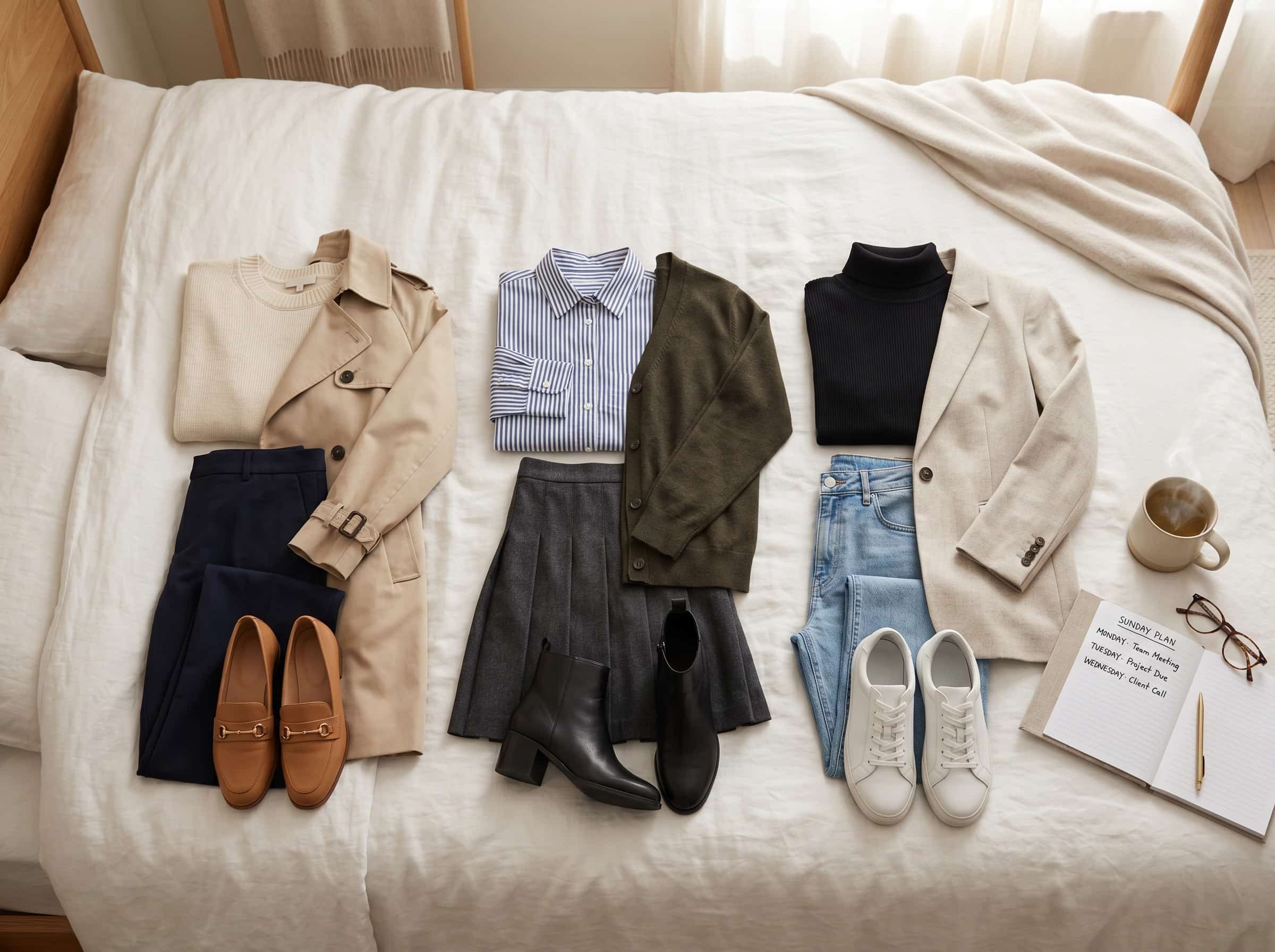
Instead, take the three or four outfit formulas you wear most often and hang each complete outfit on a single hanger. For example, hang the white tee, the olive trousers, and the beige trench together on one sturdy hanger. Hang the striped boatneck, the straight jeans, and the long cardigan together on another. Do this for your top five outfits. When Monday morning arrives, you reach for one hanger and you are done. No thinking. No pile of rejected clothes. Just one decision, executed in seconds.
The Sunday Five-Minute Habit That Saves Your Week
Busy mornings do not start on Monday. They start the night before, or better yet, on Sunday afternoon. I have a habit I taught every private client, and every single one who stuck with it told me it changed their week. It takes five minutes.
On Sunday, look at your calendar for the week. Identify the days that require a specific kind of outfit: a meeting, a coffee date, an errand day, a casual dinner. Pull those outfits from your closet and hang them in order at the front, Sunday through Friday. Check that each outfit has the shoes and undergarments it needs. That is it. Five minutes. By the time Monday morning arrives, your closet is already ready for you. You just reach for the first hanger and start your day.
A Quick Guide to Seasonal Rotation
Half of the clothes in most closets are out of season at any given time. They take up visual space, create clutter, and make it harder to see what is actually wearable. Twice a year, I do a full seasonal swap. Warm-weather clothes go into a clean storage bin under the bed or on a high shelf. Cool-weather clothes come out. The rule is simple: if you cannot wear it comfortably in the current weather, it does not belong on the main rail.
This is also the moment to assess what came back from storage. Check for any pieces that feel dated, no longer fit, or simply do not excite you. The seasonal swap is a natural editing opportunity that costs nothing and keeps your closet fresh without a shopping trip.
What Belongs at the Front and What Belongs at the Back
There is a visual merchandising trick I brought home with me, and it works beautifully. The pieces you want to wear most should live at eye level and in the front third of your closet rail. The pieces you rarely reach for should live at the edges or on higher shelves. Your closet should feel like a store where the best items are highlighted, not buried. When you open the door, your favorite, most-reliable pieces should greet you first.
This also applies to shoes. Keep the two or three pairs you wear most often on a low shelf or rack at the front. Rotate seasonal pairs to the back. Clean, accessible shoes make getting dressed feel seamless.
What to Do This Weekend
If your mornings feel harder than they should, dedicate one Saturday afternoon to the following: do the three-question edit and remove anything that fails. Group your remaining pieces into outfit formulas and hang at least three complete outfits together at the front of your closet. Move out-of-season clothes to storage. Write down your three best formulas on a small note and tape it inside your closet door as a backup on days when you feel stuck. That is the whole project. It will not take all day, and it will pay you back in calm mornings for months to come.
Final Thought: A closet should not be a source of morning anxiety. It should be a quiet, reliable tool that helps you walk out the door looking and feeling like yourself. A little editing, a little system, and a little Sunday planning is all it takes to make that happen.