I am not tall. In my years as a visual merchandiser and e-commerce stylist, I dressed models of every height, and I dressed real women who wanted to look longer and leaner without a single extra inch of heel. The secret I learned is that height is not about how tall you actually are. It is about how tall your clothes make you look. A well-proportioned outfit on a five-foot-two frame can read as taller than a poorly proportioned one on someone five-foot-eight. And the best part is that none of the strategies I am about to share require discomfort, sky-high shoes, or anyone knowing you made an effort. They are visual tricks that work quietly, reliably, and on any budget.

The Core Principle: Create an Unbroken Vertical Line
The single most effective thing you can do to look taller is to keep the eye moving up and down without interruption. Every time an outfit cuts your body into horizontal blocks — a contrasting belt, a cropped jacket hitting at the hip, ankle straps against bare legs — the eye stops and the frame shortens. When I styled mannequins for window displays, we always elongated the silhouette by minimizing horizontal breaks. The same principle applies to your body.
Think of your outfit as one continuous column. When your top and bottom are close in tone, the line flows. When you add a long outer layer in the same color family, you extend that line even further. This is not about wearing only one color forever. It is about being strategic with where you place contrast.
What Breaks the Vertical Line | What Extends It |
|---|---|
Cropped jackets that end at the hip bone | Longline cardigans or open-front blazers that fall to mid-thigh or lower |
Ankle straps on shoes, especially in contrasting colors | Nude or skin-tone shoes, or pointed-toe flats that extend the foot line |
High-contrast belt cutting the torso in half | Same-tone belt, no belt, or a belt worn under a long layer |
Cuffed or cropped pants with contrasting socks | Full-length trousers that graze the floor, or cropped pants with bare ankle and a nude shoe |
Color-blocked top and bottom in starkly different shades | Tonal dressing: varying shades of the same color family |
This table lived in my head during every photoshoot and every client fitting. It works on every single body.
The Five Proportion Rules That Add Visual Height
Beyond the vertical line principle, there are specific, repeatable rules I used in e-commerce styling to make every model look longer and leaner. Here are the five I reach for most often.
Rule 1: Raise Your Waistline
The higher your waist reads visually, the longer your legs appear. High-rise trousers, skirts, and jeans are the simplest tool you own. Tuck your top in fully or do a front-tuck to keep the waist visible. When the waist drops to the hip, the torso lengthens and the legs shorten. This is pure geometry.
Rule 2: Show Your Forearms and Ankles
The narrowest points of your limbs are your wrists, forearms, and ankles. When you expose them — by rolling a sleeve to just below the elbow or wearing a cropped trouser with a bare ankle — you create visual lightness. The eye reads the exposed skin as a continuation of the limb rather than a stopping point.
Rule 3: Choose V-Necks and Vertical Details
A V-neckline or an open collar draws the eye downward along a vertical path. Long pendant necklaces, center-front buttons, and vertical seam lines do the same thing. Avoid high, round necklines that cut straight across the collarbone if elongating is your goal.
Rule 4: Wear Pointed-Toe or Low-Vamp Flats
You do not need heels. A pointed-toe flat extends the line of the foot, creating the illusion of a longer leg. A low-vamp shoe — one that shows more of the top of the foot — has a similar effect. The more foot visible, the more the leg line continues. Nude shoes matched to your skin tone amplify this trick significantly.
Rule 5: Let Your Trousers Graze the Floor
Full-length trousers worn with flats, where the hem kisses the top of your shoe or slightly grazes the floor, create an unbroken line from hip to ground. This is one of the most underused moves in budget-friendly styling. Tailoring a trouser hem costs very little and yields enormous visual returns.

Outfit Formulas That Use These Rules
Here are three complete formulas I built for private styling clients who specifically asked to look taller without wearing heels. Each one uses the rules above in combination.
The Tonal Column
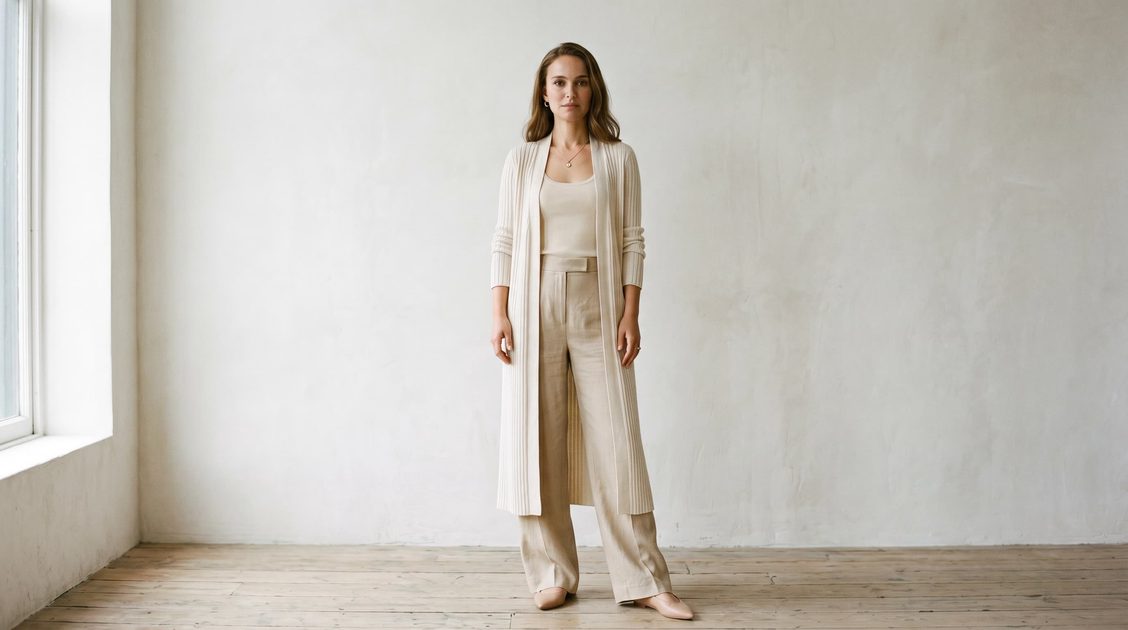
A camel or oatmeal longline cardigan worn open over a matching fine-knit tank, paired with wide-leg trousers in a slightly darker tone from the same family. Nude pointed-toe flats complete the look. The cardigan extends the vertical line. The trousers skim the floor. The shoes disappear into the leg. This is my most requested look for a reason.
The High-Waist and Crop
High-waisted straight-leg jeans in a dark wash, a slim-fit black or charcoal top tucked in completely, and a cropped jacket or structured blazer hitting at the natural waist. The waist reads high, the legs read long, and the cropped outer layer actually emphasizes the vertical line of the torso rather than breaking it. Add a pointed-toe flat or a low-heel loafer in a dark neutral.
The Dress and Duster
A midi dress in a single solid color, worn under an open longline duster or lightweight trench in a matching or slightly lighter shade. The dress creates a column. The duster adds length. A nude flat sandal or skin-tone pump keeps the footline clean. This works for casual days, brunches, and even office settings depending on the fabrics.
Common Mistakes That Make You Look Shorter
Let me address the things I saw constantly in fitting rooms that worked against a longer silhouette. Wearing oversized, boxy pieces from head to toe without a single defined point. Pairing cropped tops with low-rise bottoms. Wearing dark tights with light-colored shoes, which cuts the leg sharply at the ankle. And my most frequent correction in e-commerce styling: letting the trouser hem pool around the ankle in a heavy break. A quick hem or a single roll fixes that instantly.
How to Test This on Yourself Right Now
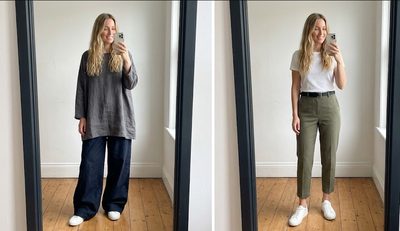
Stand in front of your full-length mirror in the outfit you have on. Take a photo. Now try one of the rules: tuck your shirt in higher, swap your dark shoes for a nude pair, or add a long open layer over your current outfit. Take a second photo. Compare the two. The difference is usually visible in seconds. I used this before-and-after photo method with every single private client, and it converted skepticism into belief faster than any explanation I could give.
Final Thought: Height is not a number on a measuring tape. It is a visual story your clothes tell. And you get to choose how that story reads.

No notes yet — write the first one.