
If you have ever stood in front of your closet frustrated because nothing looked right, even though you had plenty of clothes, you are not alone. I spent years in visual merchandising, styling mannequins and real women alike, and I learned a hard truth early: most women buy too much and think too little about how things actually work together. Looking put together does not require a closet full of expensive basics or a personal stylist on speed dial. It requires a mindset shift. Here is your step-by-step guide to dressing with more polish and more intention, all on a realistic budget.

Stop Chasing Trends and Start Building Outfit Formulas
The fastest way to waste money is to chase trends. A single trendy piece that only works with one other thing in your closet is a net loss. When I worked in e-commerce styling, I would create outfit formulas for clients who felt stuck. A formula is simply a combination of garment categories that repeat reliably.
The most foolproof formula I return to again and again is this: a simple top plus a structured bottom plus a finishing layer. That layer could be a blazer, a long cardigan, a denim jacket, or even a well-cut overshirt. The layer adds instant visual structure, which is the difference between “I threw this on” and “I put this together.”
When you shop with formulas in mind, you stop buying orphan pieces and start buying partners for what you already own.
Fit and Proportion Are Your Free Styling Tools
Most outfits fail not because the pieces are cheap, but because the proportions are wrong. You can buy a ten-dollar tee and make it look designer if the shoulder seam hits correctly and the hem ends at the right spot. You can also buy a two-hundred-dollar blazer that drags you down if the sleeves are too long and the cut overwhelms your frame.
Here is a quick reference table I use with my own clients who want to look more polished immediately, without tailoring or spending more. Use this as a checklist when you are getting dressed.
Common Fit Problem | Quick Budget Fix | Why It Works |
|---|---|---|
Sleeves too long on a jacket or shirt | Roll or push sleeves to just below the elbow, showing the forearm. | Exposes the narrowest part of the arm, creating a leaner, more intentional silhouette. |
Pants pooling at the ankle | Do a small single-roll cuff or wear a slightly cropped length. | Defines the ankle, makes any shoe look more deliberate. |
Top volume overwhelms the waist | Front-tuck or half-tuck into high-rise bottoms. | Marks the waistline and breaks up fabric bulk instantly. |
Skirt or dress hits mid-calf | Look for hems just above or just below the knee, or a slit. | The widest part of the calf often shortens the leg visually. A slit restores vertical line. |
Cardigan or jacket looks boxy | Add a slim belt over the layer at the natural waist, or choose a slightly cropped style. | Creates shape without requiring a tailored piece. |
Buy These 7 Budget Basics and You Can Stop Panic-Shopping
There are a handful of pieces that quietly hold a wardrobe together. They do not need to be expensive. They just need to be the right shape and the right neutral tones to act as a glue for the rest of your clothes. When I was building my personal styling kit for clients, this is the shortlist I started them with.
The Core 7 on a Budget
A crewneck or V-neck cotton tee in optic white and a second in a soft neutral like oatmeal or heather grey
A pair of high-rise straight-leg jeans in a clean medium wash, no heavy distressing
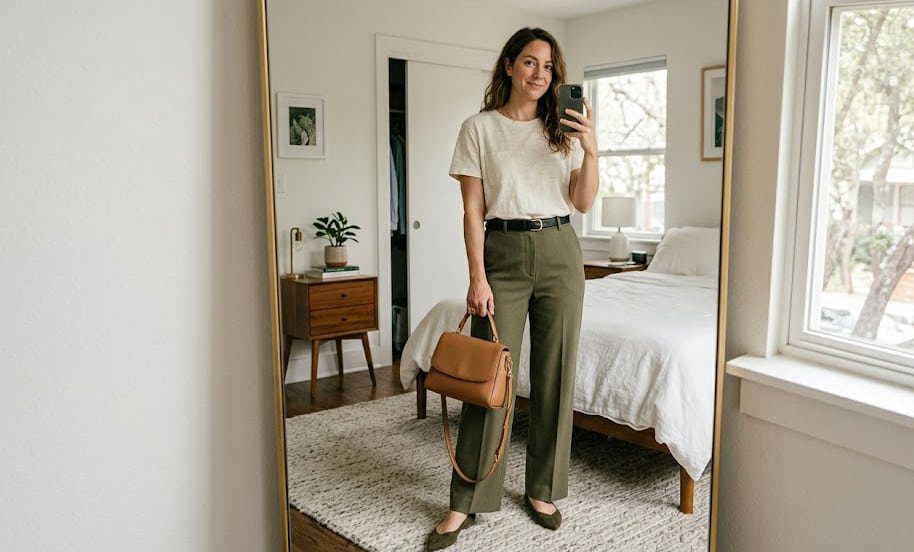
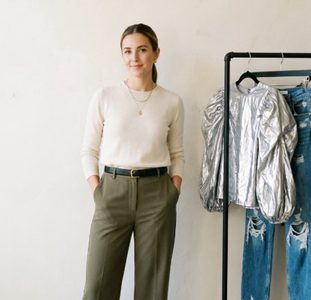
A pair of tailored trousers or wide-leg crepe pants with an elastic back waist, neutral tone
A structured layer: a relaxed blazer in beige, navy, or olive, or a long-line knit cardigan that holds its shape
A simple black leather belt with a minimal metal buckle
A clean sneaker in white or off-white and one flat or loafer in a neutral leather-look material
A structured bag: a canvas tote for day and a small crossbody with clean lines for evenings and coffee runs
With these seven pieces, you have the backbone of an entire week of outfits. Nothing clashes. Everything mixes.
Color Simplicity Always Looks More Expensive
One of the most effective tricks I used in visual merchandising was to group clothing by neutral color families on the sales floor. It made the racks look like a boutique, and it sold faster. The same psychology applies to your body. When your outfit stays within a close tonal range, your eye moves smoothly without interruption, which reads as more expensive and more polished.
For budget shoppers, this is a gift. You do not need bright statement pieces to look interesting. You need tonal texture. Wear oatmeal, sand, cream, soft black, and warm taupe together. Add a leather belt in a matching tone, and suddenly a Target sweater and Old Navy trousers look like a curated set.
How I Style an Entire Week on a Realistic Budget
Let me show you how this works in real life. Using only the core seven pieces and adding a couple of low-cost seasonal tops, here is a practical weekday outfit map that you can copy with what you already own.
Monday: White tee, olive tailored trousers, leather belt, white sneakers, canvas tote
Tuesday: Oatmeal sweater, straight-leg jeans, same white sneakers, crossbody bag
Wednesday: White tee, straight-leg jeans, beige blazer, loafers, belt, crossbody bag
Thursday: Grey tee (added piece), olive trousers again, long cardigan, white sneakers
Friday: White tee, straight-leg jeans, structured denim jacket (added piece), belt, loafers
No piece costs more than forty dollars in this lineup if sourced from places like Target, Old Navy, or resale apps. But the outfits feel cohesive and calm. That is the power of wearing things that agree with each other.
The Easiest Polish Move Costs Nothing
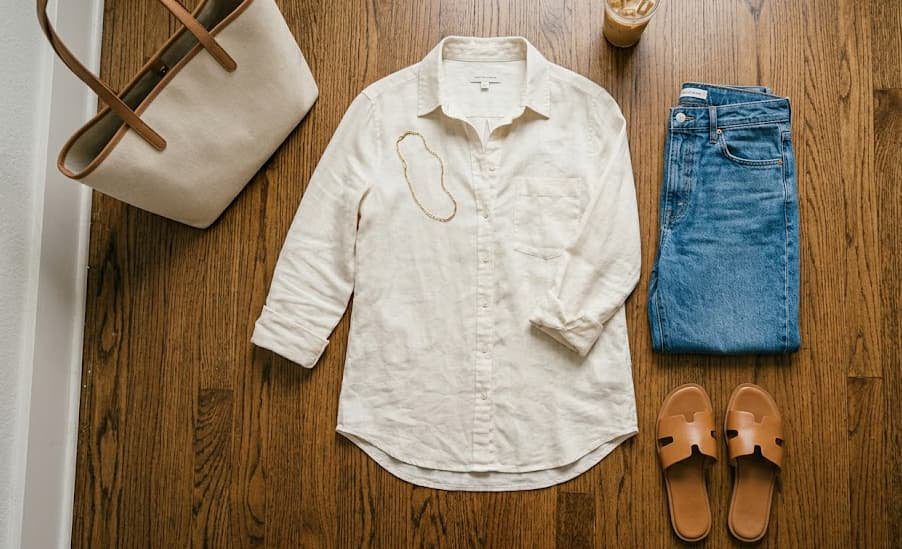
There is one tiny thing I learned in e-commerce styling that changed how I dress, and I want you to try it tomorrow morning. Before you leave the house, look at your outfit and identify your “third piece.” The first piece is your top, the second is your bottom. The third piece is the intentional add-on that frames your look. It could be a structured layer, a simple necklace, a watch, a hat, or a belt that ties it together. When you add that small deliberate choice, you signal that you thought about how you look, even if it took you ninety seconds. That is the secret most women miss.
You Don’t Need a Bigger Clothing Budget. You Need a Better Outfit Logic.
Style is not a price tag. It is a set of repeatable decisions. If you take one thing from this post, let it be this: polished women are not the ones with the most money. They are the ones who understand proportion, buy fewer pieces that work together, and pay attention to the finishing details that anyone can afford. I have dressed real women with real budgets for years, and I promise you, this approach works.
Final Thought: Looking put together shouldn’t cost a fortune. It should cost a little bit of focus. And that is entirely free.

No notes yet — write the first one.